

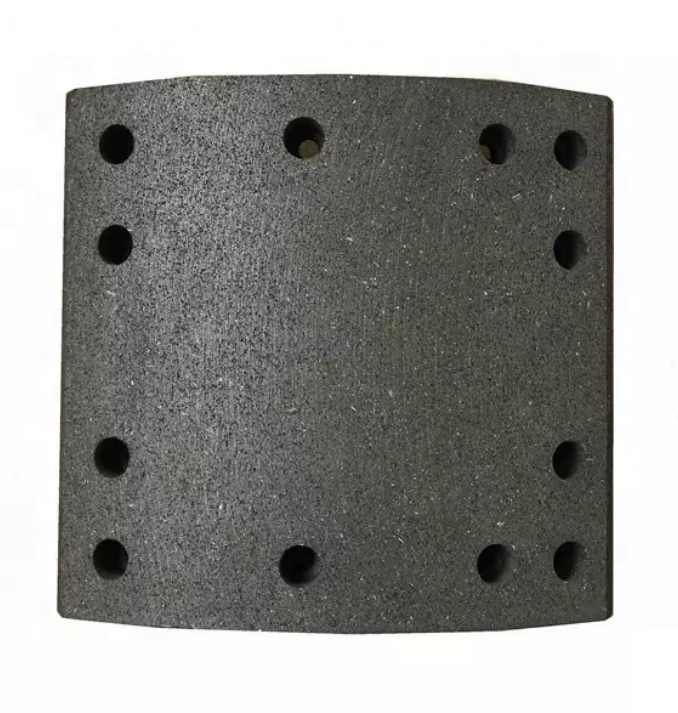
Brake Lining
Drum brake linings are a critical component ensuring vehicle braking safety, and their performance directly affects braking effectiveness and driving safety. We can provide these common compound material types based on market demand: semi-metallic friction materials, low-metallic friction materials, NAO asbestos-free organic friction materials, and ceramic friction materials. Reference numbers such as WVA, BFMC, and FMSI cover more than 200 models, widely used in major trucks and trailers in Europe, the United States, and Japan. Our brake pads meet the US FMVSS121 standard and can meet various needs from economy (20,000 lbs) to heavy-duty (25,000 lbs). For the European market, we can also provide friction pads that have passed the ECE-R90 test, ensuring worry-free braking for local customers.
Drum brake linings are a critical component ensuring vehicle braking safety, and their performance directly affects braking effectiveness and driving safety. We can provide these common compound material types based on market demand: semi-metallic friction materials, low-metallic friction materials, NAO asbestos-free organic friction materials, and ceramic friction materials. Reference numbers such as WVA, BFMC, and FMSI cover more than 200 models, widely used in major trucks and trailers in Europe, the United States, and Japan. Our brake pads meet the US FMVSS121 standard and can meet various needs from economy (20,000 lbs) to heavy-duty (25,000 lbs). For the European market, we can also provide friction pads that have passed the ECE-R90 test, ensuring worry-free braking for local customers.
The key to successfully choosing a brake lining that will be the safest choice, maximize stopping ability and
provide the best wear characteristics is to take a critical view of the “application environment” of the vehicle
– Load, Road and Frequency – and choose a lining that is well suited to meet these unique demands. All 3
elements must be considered and all three are equally as important as the other. For instance, if you make a
choice solely based on load, by discounting the effects of braking frequency, it is possible to inadvertently
“under-brake” the vehicle which could lead to increased stopping distances, excessive brake fade and
below average wear. Likewise, it would be counter-productive to choose a high temperature lining for an
application where temperatures never exceed 350°. Fulemu offers customized formulation solutions for different road and driving conditions so you can make the best choice for your specific application.
Suitable friction materials for brake linings require the following material properties:
* A suitable and stable coefficient of friction: The coefficient of friction is a key indicator of friction material performance. Ideally, friction materials should maintain a stable coefficient of friction under different temperature, pressure, and speed conditions to ensure reliable braking performance.
* Good wear resistance: Wear resistance directly affects the service life of friction materials. Materials with good wear resistance can reduce wear during braking and lower replacement frequency.
* High mechanical strength: Sufficient impact strength, compressive strength, and shear strength are required to withstand the high pressure and impact during braking, preventing material breakage, cracking, or detachment during use.
* Low braking noise: Braking noise affects vehicle ride comfort. Modern friction materials control braking noise within a reasonable range through optimized formulations and the addition of damping materials.
* Minimal wear on mating surfaces: The friction material contacts the brake drum during braking. Minimizing wear on the brake drum is crucial to extending its service life, while its own wear should also be kept low.
